
Driver logbook app: how to finish the logbook in two minutes instead of a whole evening
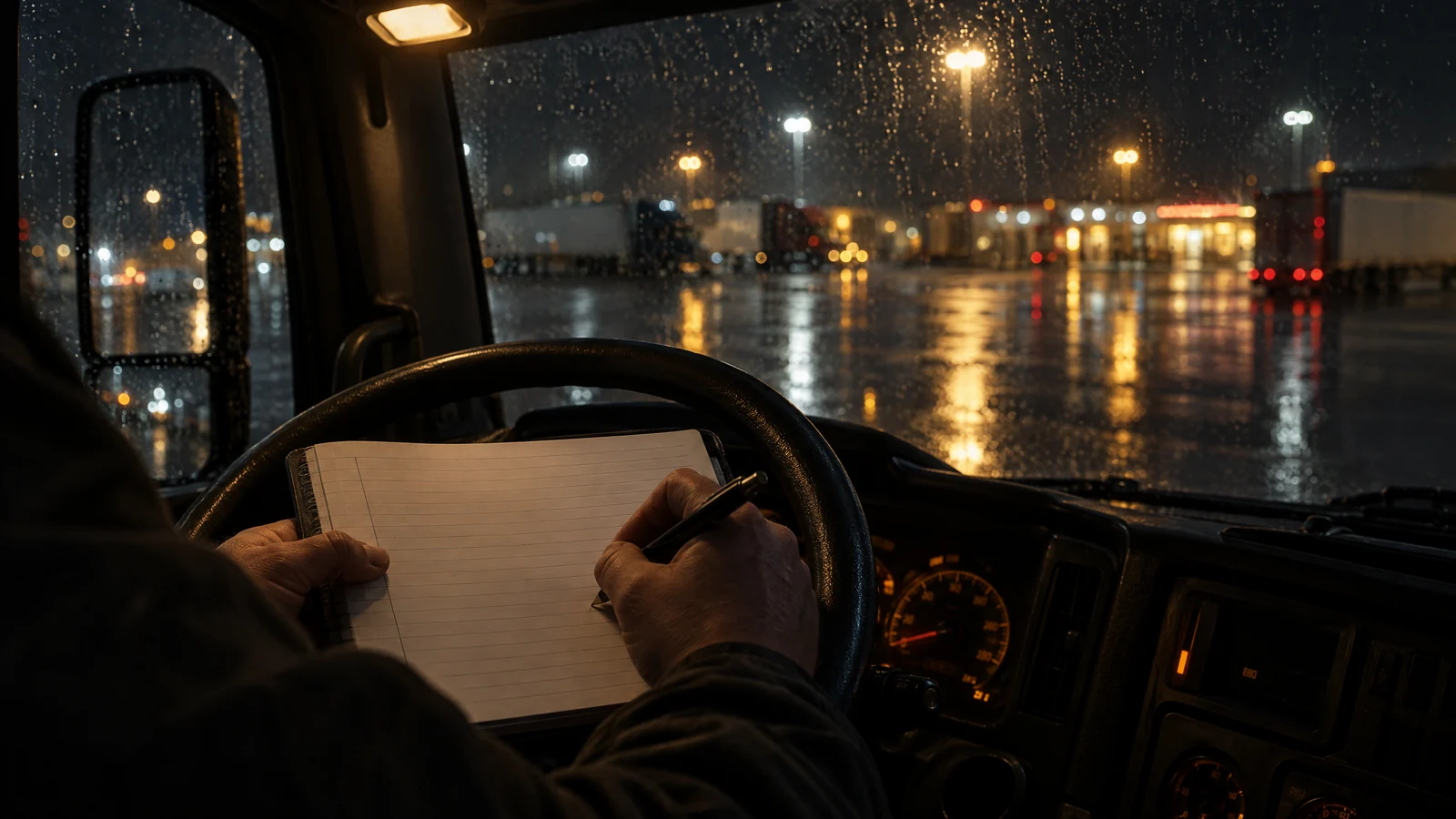
It's nine in the evening. The truck is parked, the load is delivered, the paperwork from the pickup is in the door pocket. One thing is left: the logbook. You dig out the folder, find a pen that works, and start trying to remember. What did the odometer say this morning? When did you get to the second drop? Did you fuel before or after the detour?
After one day, you remember some of it. After a week, you remember almost nothing. That is the real reason drivers hate logbooks. Not because they are complicated — because they get filled in at the worst possible moment.
What actually belongs in a driver's logbook
Every company's form looks a little different, but the core is the same everywhere:
- Vehicle and trailer — registration, and for a combination also the trailer, and when it was swapped.
- Driver — who drove, and in a two-person crew, who drove which leg.
- Date and odometer at the start — read off the dashboard, not from memory.
- The trip in legs — from where, to where, when, how many kilometres.
- Fuel — place, litres, amount, receipt number.
- Odometer at the end and total distance.
Six items. None of them is hard on its own. They only become hard when you write them down eight hours after they happened.
One thing a driver logbook app is not
Before going further, a clarification that saves a lot of confusion. In North America, "electronic logbook" often means an ELD — the device that records hours of service. In Europe, driving and rest times are recorded by the tachograph. That is a different job, regulated by law, and a logbook app does not replace it.
The logbook we are talking about here is the record of the work: where you loaded, where you unloaded, what the odometer said, how much fuel went in, which papers travelled with the goods. That is the record that settles arguments about kilometres, fuel and delivery times.
The three most expensive mistakes
Odometer from memory. You left at 312,480 and wrote 312,500. Twenty kilometres have to disappear somewhere, and they disappear in the next leg. When someone compares distance with fuel, the numbers don't add up.
The receipt in the jacket pocket. The paper is thin, the jacket goes in the wash, the receipt is gone. The logbook shows litres with nothing behind them.
Legs merged into one. Three drops in the same town written as one trip. For you it's one run. In the logbook it's one line that can't explain why the distance doesn't match the shortest route.
All three have the same cause: the gap between when something happened and when you wrote it down.
Same work, done along the way
The difference between a chore and two minutes is a single habit: you record it while you are there.
You set off — open the phone and type the odometer while you're looking at it. You fuel — enter litres and amount at the pump. You arrive at a drop — record the unloading while you wait at the dock. Each of those takes five to twenty seconds and happens at a moment when you are standing still anyway.
In the evening there is nothing left to fill in. That is the whole point of an online logbook: not moving the same paper form onto a screen, but moving the recording from the end of the day to the moment the numbers are in front of you.
What a good electronic logbook must do
Work without signal. Underground car parks, warehouses with metal roofs, empty stretches of road — you lose signal several times a day. If the app needs a connection to save one number, you won't use it exactly where you need it most. Entries must stay on the phone and send themselves when the signal comes back.
Take seconds, not minutes. Big buttons, few steps, readable in the midday sun. If an entry takes a minute, you'll postpone it — and postponed entries get written from memory.
Record the time by itself. Every entry should carry the time it was made. That timestamp is what protects you when a customer claims you arrived at half past two and you know you were at the gate at noon.
Not be quietly editable later. An electronic logbook where anyone can change a number three months afterwards proves very little. Once sent, entries should stay as they are.
What the driver gets out of it
- Your evening is yours. No folder, no memory game, no half hour with a pen.
- No phone calls three days later asking where Wednesday's receipt is.
- You have proof. Record the unloading at the gate, not in the evening, and the time speaks for you.
- Waiting time isn't just your word. A short note — "waiting for a dock since 12:10" — written on the spot weighs more than a memory a week later.
Get RUNAGA Lite
RUNAGA Lite is a driver logbook app built from the cab, not the office. You record odometer, fuel, loading and unloading during the day, while you're stopped, in a few seconds — and every entry saves its own time. When you finish the trip, the completed report goes to your boss by email as a PDF. It works without signal, speaks 29 languages, uses kilometres and litres, and does not track your location. It is not an ELD or a tachograph.
Please note: RUNAGA Lite subscriptions are currently available in the USA and most of Europe, but not in the United Kingdom.
- iPhone: App Store
- Android: Google Play